Skip to content
PAUL BANKS.
  1. ←Work

EXHIBIT · CREDIT KARMA

Credit Karma — case exhibit

Credit Karma

A Growth initiative that reframed financial health as mental health. I embedded with research — sitting in member sessions, hearing how money stress really felt. Those findings became the goal-setting flows I designed, on a platform serving 140M+ members.

Role
Sr / Lead Product Designer
Year
2019–2022
Duration
3 years
Tools
Figma · Dscout · UserTesting · Miro · Amplitude

BRAND SPECIMEN

01

THE PROBLEM

Financial health is mental health.

I joined this on the design side, in the sessions with members rather than reading the deck after. What I heard was that money stress wasn't a fringe case. It was the baseline: present hardship stacked on the anticipation of setbacks still to come.

77%of members were experiencing stress over their financesCredit Karma member research
  • Ability to pay bills and rentGoing without essentials, housing insecurity
  • Income stabilityLoss or reduced income
  • Loss of savingsHaving enough saved, retirement
  • Ability to pay debtCompounding debt
  • Financial market stabilityStock market losses
  • Job security
  • I'm in a gray fog, trapped underwater.
  • I'm trapped under a heavy weight.
  • I'm on a never ending rollercoaster.
  • I'm in a dark tunnel but cannot reach the end.

Dscout diary study · N = 300

02

THE MECHANISM

Stress quietly erodes the capacity to manage money.

The research surfaced a mechanism, not just a mood. Declines in mental and physical health create cognitive barriers across attention, motivation, and planning, and those barriers measurably reduce a member's ability to make financial decisions. The detail that stuck with me from the sessions: the first thing to break down is the ability to set a goal.

  • Attention & memory

    • Worse rates from no comparison
    • Forgetting account info
    • Forgetting to pay bills
  • Communication

    • Misunderstanding terms
    • Avoiding creditors and counselors
    • Harder to talk it through
  • Motivation

    • Avoidance
    • Feeling resigned or helpless
    • Denial and disengaging
  • Planning decisions

    • Difficulty setting goals
    • Can't sequence the steps to solve problems
    • Hard to build and keep a budget
  • Response inhibition

    • Reckless spending that compounds debt
    • More impulsive decisions
    • Spending as self medication

Capability framework: Money & Mental Health Policy Institute

03

THE INSIGHT

Goals are the lever that reverses the spiral.

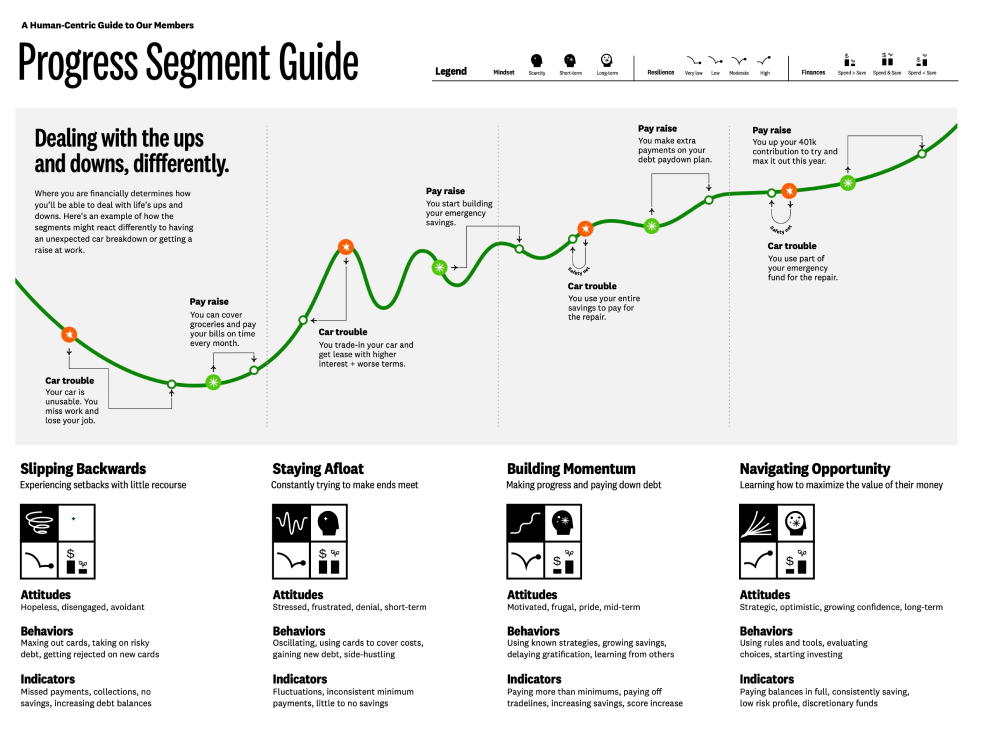
If stress erodes goal-setting, that's also the opening. The research pointed to the lever: futures thinking, naming and visualizing a long-term goal, lowers stress and helps members feel in control. On our member journey, it's the move from Staying Afloat to Building Momentum.

  1. Slipping BackwardsExperiencing setbacks with little relief
  2. Staying AfloatConstantly trying to make ends meet
  3. Building MomentumMaking progress and paying down debt
  4. Navigating OpportunityLearning to maximize the value of their money

Member segmentation survey · N = 14,980

04

THE DESIGN RESPONSE

Help members define, articulate, and commit to a goal.

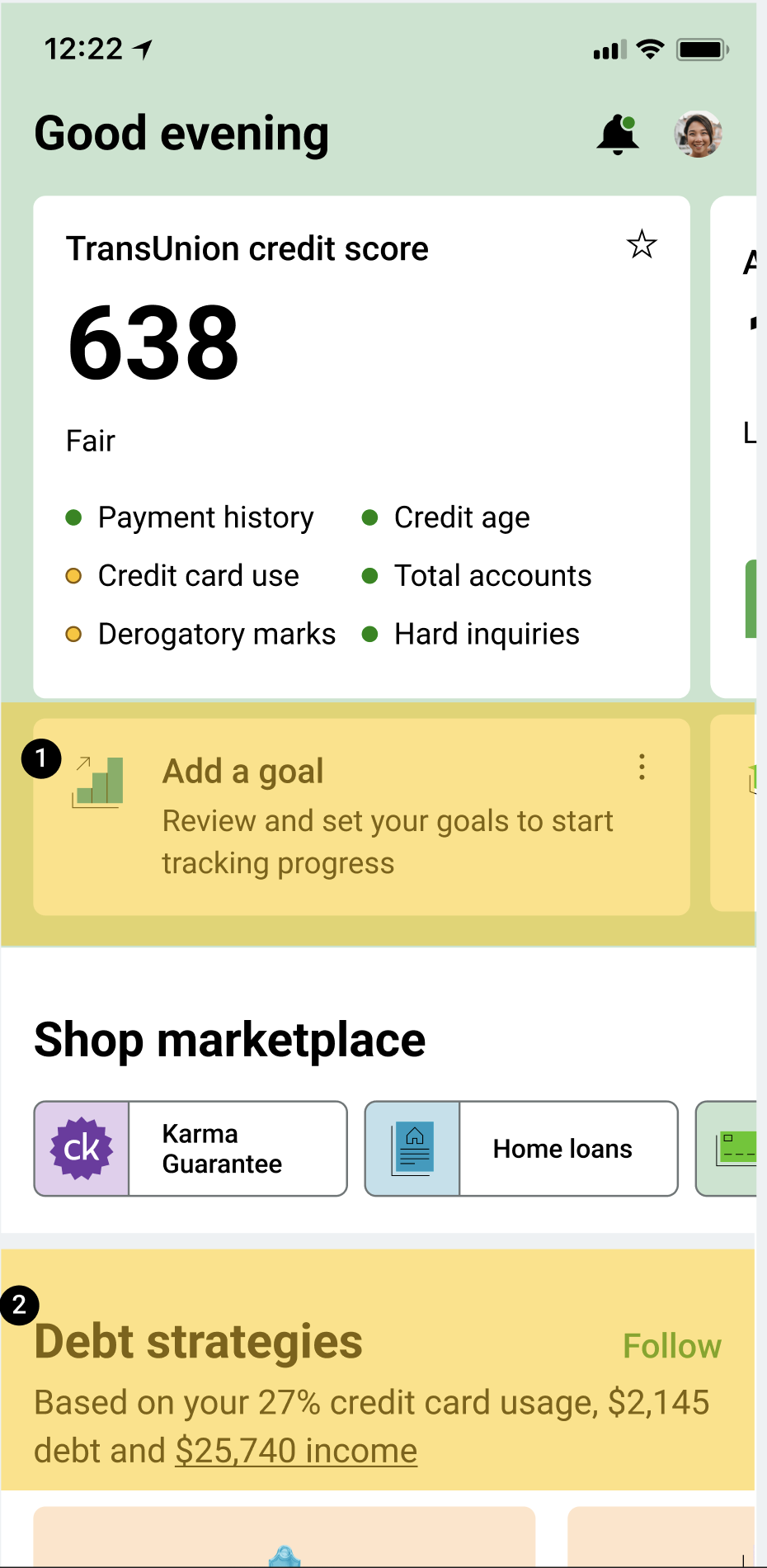
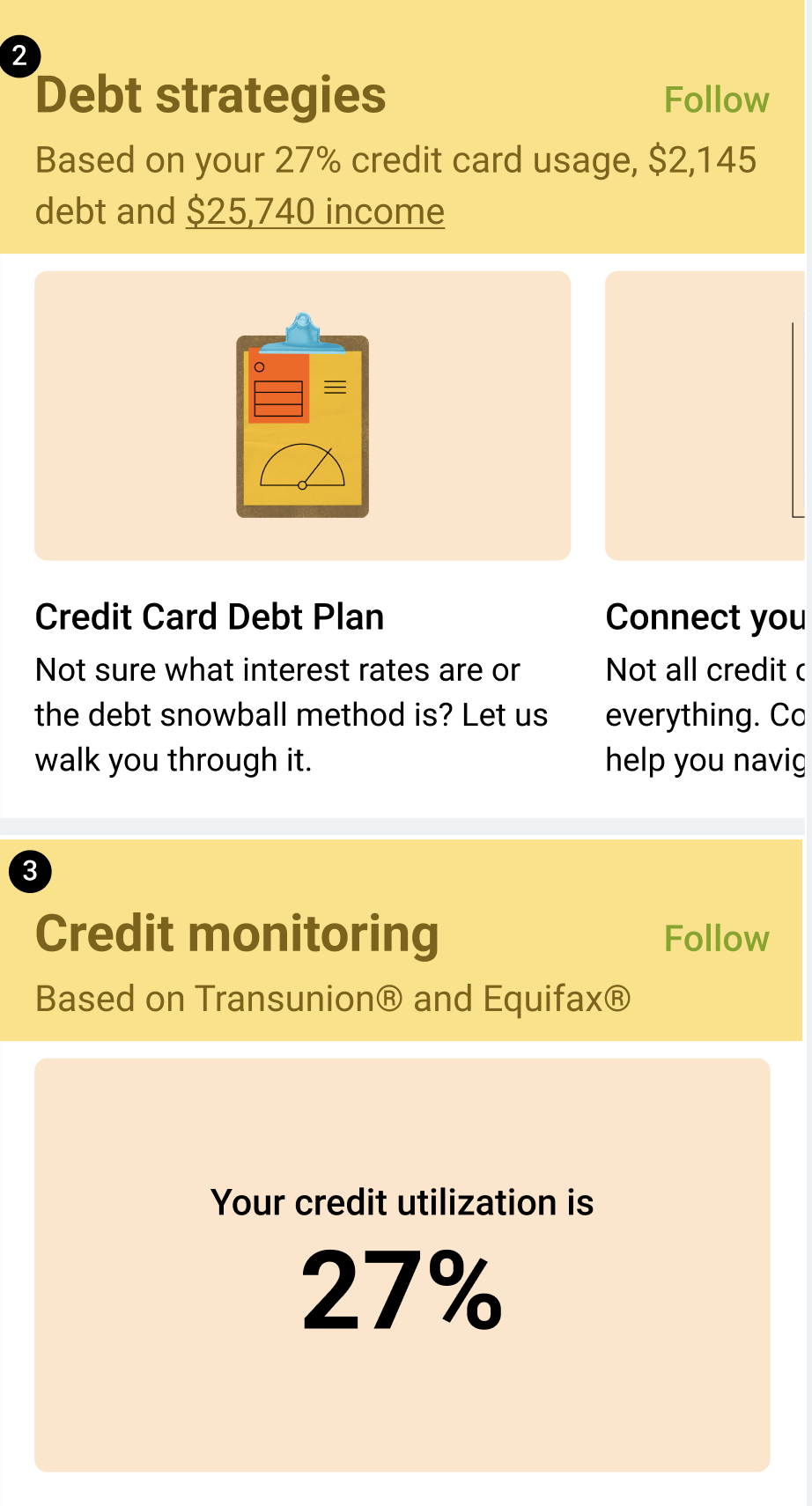
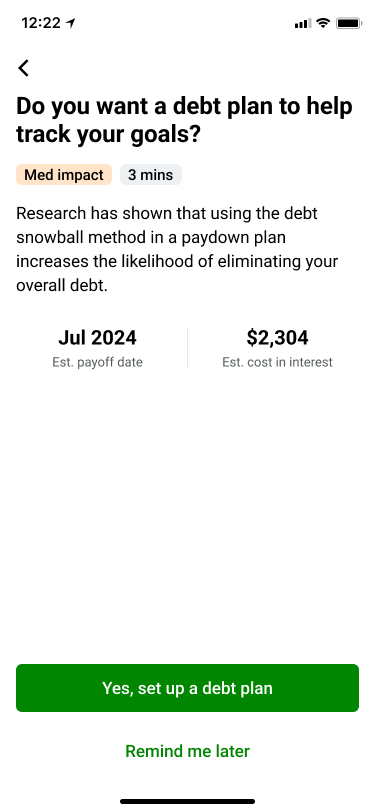
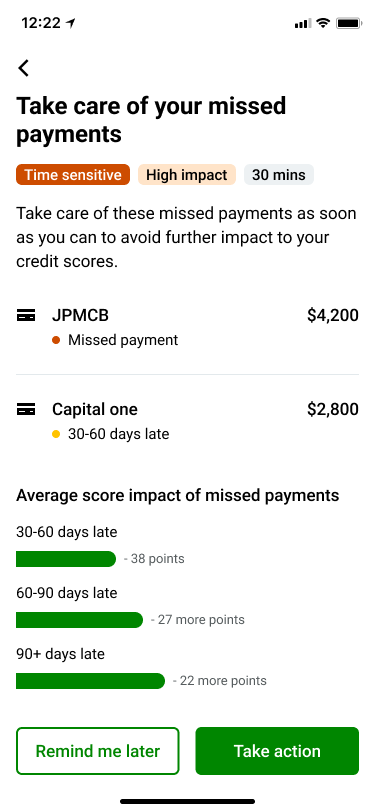
This is where my work lived. I designed goal-setting as a first-class member flow and tested it with the same members we'd heard from. Capture a goal, connect it to the features that move it, and reflect progress back as something that feels less like a credit score and more like control. The interaction on the work index is that flow, distilled.

  • What if we used our product to help members better define and articulate their goals?
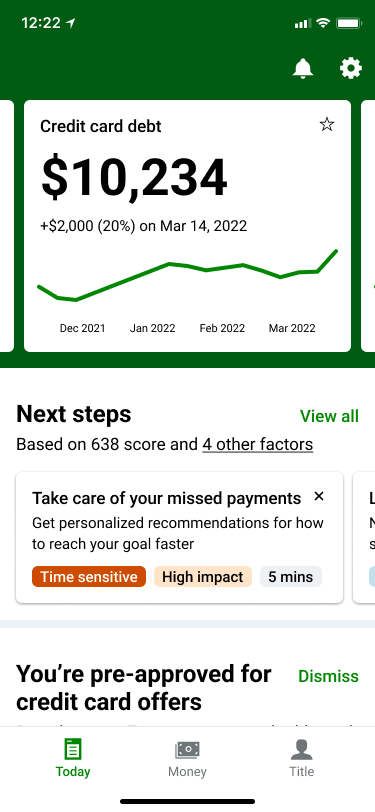
  • The shipped member flow: from score, to choosing goals, to a home that organizes around them.

05

THE STRATEGY

From insight to a roadmap the team could ship against.

The work fed a Now / Next / Later roadmap the team carried forward: product principles, new success metrics for member progress and mental state, and a shared goal of reducing financial stress. My design response anchored the near-term work.

  • Now

    • Product principles and design criteria for financial stress
    • Internal education on how the credit system works
  • Next

    • Audit content for quick wins that reduce stress
    • New UX success metrics for member progress and mental state
    • A shared cross team goal to reduce financial stress
  • Later

    • Bring in financial stress SMEs and therapists across product and marketing
    • Explore how the product could tackle mental health directly
    • Internal metrics for how well we reduce member stress
  1. GOAL-SETTING MEMBER FLOW

    I designed goal-setting as a first-class member flow, capturing a goal as an artifact and connecting it to the features that move financial health.

    Tested with members and aligned to the journey from Staying Afloat to Building Momentum.

    View presentation →

Directive: [ STATUS: OBSERVING_HUMANS ]

INFOINFO
Paul Banks[ ID: BANKS_P ]

CHARLOTTE_NC // --:-- EDT

Paul Banks

Architect of Intent

Designing for humans, engineering for agents. After 19 years extracting human patterns, I've pivoted from crafting static interfaces to architecting autonomous systems — building the logic that helps agents understand what people actually need.

> INITIATE_DOWNLOAD: PAUL_BANKS_RESUME.PDF> SEE: BRAND_VOICE_WORK

STATUS: OBSERVING_HUMANS

Directory_01Directory_01

  • INDEX
  • PORTFOLIO
  • DESIGN_SYSTEM
  • RESUME

Directory_02Directory_02

  • THE_PROBLEM
  • THE_PROCESS
  • THE_PROOF
  • THE_PRICE
  • FAQ

Comms_LinkComms_Link

  • EMAIL
  • LINKEDIN
  • BOOK_CALL

Contact_ProtocolContact_Protocol

> LET'S_CHAT

SEQ: 2026.01

SYS.ARCHITECT: PAUL_BANKS // ALL_RIGHTS_RESERVED